
What Makes Asbestos Bad for You?
Published by Remtech Environmental Team · Last updated April 2025
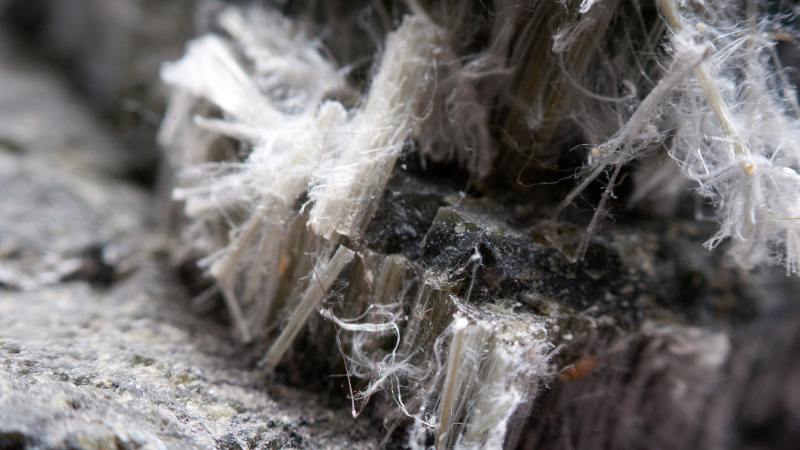
In our experience at Remtech Environmental, most people are aware that asbestos poses significant health risks, such as an increased risk of certain lung cancers. However, not everyone understands why asbestos has such a damaging effect on people’s health or why it increases the risk of these diseases. In this article, we will provide an overview of what exactly makes asbestos bad for you.
What Is Asbestos?
First, allow us to explain what exactly asbestos is. Asbestos is the name given to certain minerals which form into bundles of thin fibers. These fibers can then be separated into long, durable threads and used to manufacture a variety of other goods. Asbestos fibers have many useful properties, such as heat resistance, fire protection, and more, which is why these minerals were so widely used in construction and manufacturing.
What Makes Asbestos Harmful?
Asbestos is hazardous to your health because of its tiny fibers. Its fibers are so fine they can be breathed in, where they can easily become trapped in the lungs. When asbestos fibers get stuck in your lungs, they can cause a variety of health problems, including inflammation and scarring, and make it difficult to breathe. Some types of asbestos fibers are also sharp enough to penetrate individual cells, damaging the nucleus and making those cells more likely to mutate and become cancerous. Prolonged exposure to asbestos can therefore significantly increase the risk of some types of cancer, including cancers of the lung, larynx, and ovaries, as well as of the thin membranes lining the chest and abdomen. (This last type is known as mesothelioma.)
Most North Carolinians know in a general way that asbestos is dangerous, but the specifics of why it harms the human body, how long the damage takes to surface, and which fiber types pose the greatest risk are poorly understood even among contractors and home inspectors. The science matters because it shapes everything from regulatory thresholds to the personal protective equipment our crews wear on every job. Asbestos is not toxic in the way that lead or cyanide is toxic. It does not poison cells through chemical reactions. Instead, the harm comes from physical fiber geometry combined with biological persistence, a combination unique to a small group of mineral fibers. This article unpacks the biological mechanism, the four major diseases caused by inhaled asbestos fibers, the long latency periods that make exposure history so important, and the practical implications for homeowners in the Triangle who may be living above or beside legacy asbestos-containing materials.
The Four Major Diseases Caused by Asbestos Exposure
EPA, OSHA, the National Cancer Institute, and the World Health Organization all classify asbestos as a Group 1 human carcinogen, meaning the evidence linking exposure to disease in humans is conclusive. Four conditions account for the overwhelming majority of asbestos-attributable illness, and each has a distinct biological mechanism, latency period, and prognosis.
Mesothelioma - The Signature Asbestos Cancer
Mesothelioma is a rare and aggressive cancer of the mesothelium, the thin protective lining surrounding the lungs (pleura), abdomen (peritoneum), heart (pericardium), or testes. It is so strongly associated with asbestos that the diagnosis itself is treated as evidence of past exposure in epidemiological work. Pleural mesothelioma accounts for roughly 80 percent of cases. Latency from first exposure to clinical diagnosis runs 20 to 50 years, with a median around 35 to 40 years. Symptoms include chest pain, persistent shortness of breath, dry cough, and unexplained weight loss. Five-year survival remains under 12 percent despite advances in surgery, chemotherapy, and immunotherapy. Even brief or low-level exposures - a single home renovation, a few weeks on a job site - have been linked to mesothelioma decades later, which is why occupational and bystander exposure is taken so seriously.
Asbestosis - Progressive Lung Scarring
Asbestosis is a chronic, irreversible interstitial lung disease caused by the body's inflammatory response to retained asbestos fibers in the lung tissue. Macrophages attempt to engulf fibers, fail because the fibers are too long, and release cytokines that drive ongoing inflammation and fibrosis. Over years, this fibrosis stiffens the lungs, reduces gas exchange, and produces progressive dyspnea. Unlike mesothelioma, asbestosis generally requires moderate to heavy cumulative exposure, classically seen in shipyard workers, insulators, asbestos miners, and demolition crews who worked unprotected. Latency runs 10 to 40 years. There is no cure - treatment focuses on symptom management, oxygen therapy, pulmonary rehabilitation, and aggressive vaccination against respiratory infections that can be fatal in compromised lungs. Imaging shows characteristic bilateral lower-zone reticular opacities, and biopsy reveals asbestos bodies - fibers coated in iron-protein complexes.
Lung Cancer - Multiplicative Risk With Smoking
Asbestos exposure independently increases the risk of bronchogenic carcinoma, the most common form of lung cancer, by a factor of roughly five compared to unexposed individuals. The mechanism appears to involve direct DNA damage from fibers piercing cell nuclei, chronic inflammation generating reactive oxygen species, and impaired clearance of other carcinogens. The most striking finding is the multiplicative interaction with tobacco smoke. A non-smoker exposed to asbestos has about five times the lung cancer risk of an unexposed non-smoker. A smoker exposed to asbestos has roughly 50 to 90 times the risk. Latency runs 15 to 35 years from first exposure. Smoking cessation dramatically reduces but does not eliminate the elevated risk, which is why former asbestos workers who quit smoking still benefit from low-dose CT screening protocols.
Pleural Plaques and Pleural Thickening
Pleural plaques are localized areas of calcified fibrosis on the parietal pleura, often discovered incidentally on chest imaging. They are the most common manifestation of past asbestos exposure and serve as biomarkers - their presence on a CT scan strongly suggests historical fiber inhalation even when the patient does not recall significant exposure. Plaques themselves are usually asymptomatic and not considered precancerous, but they substantially raise the index of suspicion for other asbestos-related diseases and warrant closer pulmonary surveillance. Diffuse pleural thickening, a related but more extensive condition, can restrict lung expansion and produce dyspnea on exertion. Latency for both ranges from 15 to 40 years. For patients with documented occupational exposure, the American Thoracic Society recommends pulmonary function testing and high-resolution CT every two to five years.
Other Confirmed and Suspected Cancers
Beyond the four main conditions, the International Agency for Research on Cancer has confirmed a causal link between asbestos exposure and cancers of the larynx and ovaries. Suggestive but less conclusive evidence ties asbestos to colorectal, pharyngeal, and stomach cancers. The NC DHHS and the federal Agency for Toxic Substances and Disease Registry both treat these associations as plausible enough to inform medical surveillance protocols for individuals with documented occupational exposure. The takeaway is that asbestos is a systemic carcinogen, not solely a lung hazard, and clearance from a chest scan does not equate to clearance from all asbestos-related risk. Mechanistically, fibers swallowed in mucus or carried by the lymphatic system reach abdominal and pelvic tissues, which explains the peritoneal mesotheliomas and ovarian cancers seen in long-term occupational cohorts.
Fiber Type, Geometry, and Why Amphiboles Are Worse Than Chrysotile
Not all asbestos is biologically equivalent. The mineral group divides into two families with very different properties. Serpentine asbestos, represented by chrysotile or white asbestos, has curly, flexible fibers and accounted for roughly 95 percent of all commercial asbestos used in the United States. Amphibole asbestos - including amosite (brown asbestos), crocidolite (blue asbestos), tremolite, anthophyllite, and actinolite - has straight, needle-like fibers that are far more rigid. The geometry matters because lung clearance mechanisms can partially break down and remove curly chrysotile fibers over months to years, while straight amphibole fibers resist clearance and persist in lung tissue for decades. Crocidolite in particular is the most potent mesothelioma-inducing fiber known, and even brief exposures in mining communities have produced epidemic mesothelioma rates. The fiber geometry also explains why long, thin fibers above five micrometers in length and below three micrometers in diameter - the so-called Stanton hypothesis dimensions - are most carcinogenic. They are short enough to reach the deep alveoli on inhalation but long enough to defeat macrophage phagocytosis. In practical terms, chrysotile dominated U.S. flooring, joint compound, and gasket products, while amphiboles were more common in pipe insulation, fireproofing spray, and certain ceiling tiles. North Carolina building stock contains both, and any sample collected on a Triangle abatement project should be analyzed by PLM with confirmation by transmission electron microscopy when fiber identification is critical.
How Exposure Actually Happens in NC Homes - and How to Prevent It
Asbestos in an undisturbed wall, ceiling, or floor poses negligible risk. The danger arises when fibers become airborne and respirable, which happens through three main mechanisms relevant to homeowners. First, mechanical disturbance during renovation, demolition, or DIY repair - cutting, sanding, drilling, scraping, or breaking suspect materials. Second, weathering and degradation of aging materials, particularly outdoor cement-asbestos siding, roofing, and transite pipe, where decades of UV and freeze-thaw eventually liberate fibers. Third, secondary disturbance from water damage, fire, rodent activity, or HVAC operation that picks up settled fibers and re-suspends them throughout a home. Once airborne, fibers travel deep into the lungs because they are too small to be filtered by nasal hair or mucous traps, and the body's defenses are largely ineffective. Prevention is straightforward in principle. Identify suspect materials before any disturbance through professional sampling. Leave intact materials alone when possible - encapsulation or non-disturbance is often the right answer. When abatement is needed, hire only NC HHCU licensed contractors who use negative-pressure containment, HEPA filtration, wet methods, full Tyvek and P100 respirator protection, and third-party clearance air sampling. Never use a household vacuum on suspect dust. Never sand or grind suspect materials. Disease latencies of 20 to 50 years mean today's exposure shows up decades later, and the only effective intervention is preventing inhalation today.
Related Articles From Remtech Environmental
If this overview of asbestos health effects raised questions about your own home, our blog has additional practical reading. Understanding the basics of asbestos flooring walks through identification of vinyl-asbestos tile, sheet vinyl with asbestos paper backing, and asbestos linoleum, plus the technical challenges of removal. Our story-driven post titled what did you do about the asbestos follows a Raleigh homeowner who unknowingly remodeled an asbestos-laden home and illustrates the real-world cost of skipping pre-renovation testing. For service information, visit our full asbestos abatement page covering inspection, abatement design, removal, and clearance, or request a free quote for a pre-renovation environmental inspection in the Triangle.
Key Takeaways
- Asbestos causes four main diseases - mesothelioma, asbestosis, lung cancer, and pleural plaques - each with distinct latency and severity profiles.
- Latency periods of 15 to 50 years mean today's exposure produces tomorrow's disease, making prevention the only effective intervention.
- Amphibole fibers like crocidolite and amosite are far more carcinogenic than chrysotile because their straight geometry resists lung clearance.
- Smoking and asbestos exposure interact multiplicatively, raising lung cancer risk 50 to 90 fold compared to unexposed non-smokers.
- Intact materials pose minimal risk - the danger arises only when fibers become airborne through disturbance, weathering, or secondary contamination.
Need Help with Environmental Services?
If you have concerns about mold, asbestos, or water damage in your property, contact Remtech Environmental today for a free consultation.
Get a Free Quote