
What You Should Know About Asbestos
Published by Remtech Environmental Team · Last updated April 2025
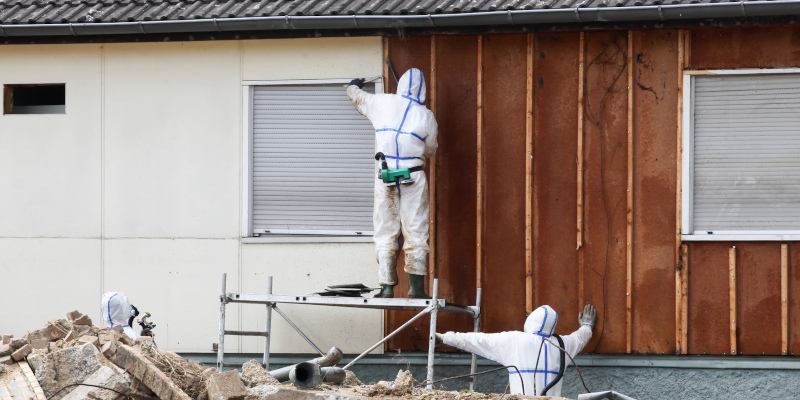
Asbestos is a strong, heat-resistant mineral that has been used extensively in manufactured goods and building materials for its insulating ability and resistance to burning. It can be found in some insulation, floor tiles, shingles, textured paints, and elsewhere in walls, floors, attics, and home appliances.
If disturbed, asbestos poses a significant threat to a person’s health, ranging from irritation to cancer. It can become a problem if asbestos-containing materials begin to break down or if it is damaged or disturbed due to remodeling, maintenance, or general repair. This can cause asbestos to release particles and fibers into the air, where they can become a threat to a person’s health.
It can take years for symptoms of asbestos exposure to manifest, and significant damage may already be done at that point. Therefore, it is important to address the issue even if very low levels of asbestos are present. Older construction, especially buildings built in 1979 or earlier, are more likely to contain asbestos-containing materials. There are regulations regarding asbestos, but for most applications, there is not a ban on its usage in the United States. It can still be found in materials that can be purchased at local and chain hardware stores.
At Remtech Environmental, we can recommend trusted asbestos-testing professionals. If a problem is found, we are qualified and prepared to tackle the removal process. We have 30 years of experience in environmental cleanup and seek to educate clients, not scare them. Asbestos removal is important, but we encourage people to remain calm and trust us to fulfill our passion of helping to mitigate the problem. If you have asbestos, or suspect you might, give us a call today to start the removal process.
Asbestos sits inside one of the most layered regulatory frameworks in environmental law, and North Carolina property owners often discover the rules only after a renovation, sale, or insurance claim forces the issue at an inconvenient moment. State authority flows from 15A NCAC 19C, federal authority comes through the Clean Air Act NESHAP program and OSHA's worker-protection standards, and additional obligations attach through real estate disclosure law and standard property insurance policy language. Understanding how these instruments interact is what separates a smooth abatement project from a stop-work order, a denied claim, or a costly closing renegotiation. This article maps the regulatory and legal landscape that governs every commercial demolition, residential renovation, multifamily retrofit, and property transaction involving suspected asbestos-containing materials in our service area. The goal is to give Raleigh, Durham, and Chapel Hill stakeholders a working command of the citations and agency contacts they will encounter on permits, contractor invoices, and disclosure forms.
The Regulatory and Legal Architecture Property Owners Encounter
Five distinct authorities govern asbestos handling in North Carolina, and each one carries its own scope, enforcement mechanism, and documentation requirement. Reviewing them in sequence shows how a single residential project can trigger overlapping obligations, and why working with accredited professionals is the practical path to compliance.
15A NCAC 19C: The State Asbestos Hazard Management Rules
North Carolina's primary asbestos regulation lives in Title 15A, Subchapter 19C of the Administrative Code, administered by the Health Hazards Control Unit within the Division of Public Health. Section .0600 governs accreditation and certification of inspectors, management planners, project designers, supervisors, and abatement workers, while sections .0500 and .0700 establish performance standards for inspection, containment, removal, and waste handling. The rule applies to virtually every facility except certain owner-occupied single-family residences when the owner performs the work personally without commercial intent. Triangle commercial buildings, schools, multifamily housing, and any contracted residential project fall squarely within scope. Penalties for violation range from civil monetary fines to criminal referral, and the state publishes enforcement actions quarterly so the public record is searchable.
EPA NESHAP and the Asbestos Demolition Notification Process
The federal National Emission Standards for Hazardous Air Pollutants codify asbestos handling in 40 CFR Part 61, Subpart M. NESHAP requires a thorough inspection before any demolition or renovation that will affect threshold quantities of regulated asbestos-containing material, defined as 260 linear feet of pipe insulation, 160 square feet of surfacing material, or 35 cubic feet of facility components. Owners must file a written notification with the state at least ten working days before the project begins, identify the abatement contractor, describe the work practices, and disclose the disposal facility. Failure to file is one of the most commonly cited violations, and the EPA pursues civil penalties up to roughly 60,000 dollars per day per violation under current Federal Civil Penalties Inflation Adjustment Act amounts.
OSHA Standards 1910.1001 and 1926.1101 for Worker Protection
Workers face two parallel OSHA rules. The general industry standard at 29 CFR 1910.1001 covers manufacturing, warehouse, and facility-maintenance settings, while the construction standard at 29 CFR 1926.1101 governs renovation, demolition, and abatement work. Both establish a permissible exposure limit of 0.1 fibers per cubic centimeter as an eight-hour time-weighted average and an excursion limit of 1.0 fibers per cubic centimeter over thirty minutes. The construction rule classifies tasks into four categories with progressively stringent control requirements, mandates medical surveillance for workers exposed above the action level, and requires written exposure assessments. Property owners who hire abatement contractors should confirm respiratory-protection programs, fit-test records, and training certificates as part of the contract due diligence, because OSHA can and does pursue host-employer liability under the multi-employer worksite policy.
North Carolina DHHS Asbestos Hazard Management Program
Day-to-day enforcement of state and federal asbestos rules in North Carolina runs through the Asbestos Hazard Management Program housed inside the Department of Health and Human Services. The program maintains the public database of accredited inspectors, project designers, supervisors, abatement workers, and management planners, accepts NESHAP notifications, conducts unannounced compliance inspections, and investigates citizen complaints. Property owners can verify a contractor's accreditation status online before signing any agreement, which is the single most effective due-diligence step available to a layperson reviewing bids. The program also publishes guidance documents on school AHERA inspections, public-building surveys, abatement project design, and demolition planning that align state expectations with federal mandates, reducing the chance of conflicting interpretations during an active project on a tight schedule.
Real Estate Disclosure and Insurance Policy Implications
Sellers complete the Residential Property Disclosure Statement under N.C. General Statute 47E, which expressly references asbestos among the hazardous conditions that must be addressed in writing before contract acceptance. Commercial transactions typically incorporate environmental representations and warranties tied to a Phase I Environmental Site Assessment performed under ASTM E1527-21, and asbestos surveys are routinely scoped as a separate AHERA-style inspection with its own bulk-sample protocol. Insurance carriers respond differently depending on the policy form in question. Standard homeowner forms exclude pollution-related losses including asbestos, while commercial property and liability policies often carry specific asbestos endorsements and require professional remediation as a condition of coverage. Misrepresenting the known presence of asbestos on a policy application can void coverage entirely, so buyers and sellers alike benefit from coordinated disclosure rather than ad-hoc handling during the closing rush.
How These Authorities Interact During a Single Project
The regulatory web becomes concrete when you walk through an actual demolition. Imagine a 1972 office building in downtown Durham scheduled for partial gut renovation. The owner first commissions an AHERA-style inspection conducted by a North Carolina accredited inspector, satisfying both NESHAP and 15A NCAC 19C survey requirements. The inspection report identifies regulated asbestos quantities exceeding the NESHAP thresholds, which triggers the ten-working-day notification window. The owner files the notification electronically with the Asbestos Hazard Management Program and selects a licensed abatement contractor whose accreditation status is verified through the state database. The contractor prepares a project design under NCAC requirements, develops an OSHA-compliant exposure assessment, and submits the design to the building owner along with proof of worker training cards, medical surveillance records, and a respiratory protection program. During the work, the contractor maintains negative pressure inside the regulated area, performs aggressive air sampling at completion, and meets the clearance standard before tearing down containment. Waste manifests document disposal at an approved Subtitle D landfill, and the owner retains records for at least three years to support any future insurance claim or property transaction. Each step ties to a specific citation, and each citation creates an enforcement hook. Skipping any one of them invites stop-work orders, fines, reopened insurance issues, and potential personal liability. Understanding the architecture in advance lets owners scope budgets accurately and protects every party from the cascade of consequences that a non-compliant project can produce.
Compliance Steps Every Owner Should Document
Build a regulatory file at the very start of any project that may involve asbestos, even if you ultimately confirm the materials are clean. The file should contain the inspector's accreditation certificate, the bulk sample chain-of-custody records, the laboratory analytical reports, and the full inspection narrative. If the inspection identifies regulated asbestos, add the NESHAP notification confirmation, the state acknowledgment, the contractor's accreditation certificates and worker rosters, the project design, the air monitoring plan, and the daily logs of exposure measurements. After completion, file the air-clearance reports, waste manifests, and final disposal certificates from the receiving landfill. For real estate transactions, attach a redacted version of this file to the disclosure documents so buyers can confirm regulatory closure rather than relying on seller representation alone. For commercial property owners, share the file with your insurance broker so policy endorsements accurately reflect the remediated condition. Owners pursuing federal or state grants, low-income housing tax credits, or historic preservation tax credits will find that funding agencies frequently require the same documentation, and projects that maintain clean files breeze through the subsequent compliance reviews. The administrative effort is modest compared to the consequences of an enforcement action, a denied claim, or a closing collapse during due diligence. Treat the file as a permanent property record that travels with the deed.
Round Out Your Understanding With Related Articles
Once you have the regulatory framework in hand, the practical homeowner perspective in our companion guide on essential asbestos basics will help you operationalize compliance at the residential scale, including walk-through technique, sample collection sequencing, and disclosure timing during a sale. For readers more interested in the unexpected sources of exposure that fall outside the normal regulatory triggers, our article on lesser-known asbestos facts covers vermiculite from Libby Montana, contaminated talc, post-disaster fiber clouds, and imported consumer goods. Together with our service descriptions for commercial abatement, NESHAP notification preparation, project design, and post-remediation air clearance, this set of resources gives owners and operators a complete decision toolkit for any situation.
Key Takeaways
- 15A NCAC 19C is the primary North Carolina asbestos regulation, administered by the Health Hazards Control Unit within the Division of Public Health.
- EPA NESHAP at 40 CFR Part 61 Subpart M requires written notification at least ten working days before any demolition or renovation that exceeds threshold asbestos quantities.
- OSHA standards 1910.1001 and 1926.1101 set a permissible exposure limit of 0.1 fibers per cubic centimeter and impose strict worker-protection and medical-surveillance duties.
- The North Carolina DHHS Asbestos Hazard Management Program maintains the public database of accredited professionals and accepts NESHAP notifications.
- Standard homeowner insurance excludes asbestos pollution losses, so coordinated disclosure under N.C. General Statute 47E and proper documentation are essential during real estate transactions.
Need Help with Environmental Services?
If you have concerns about mold, asbestos, or water damage in your property, contact Remtech Environmental today for a free consultation.
Get a Free Quote