
Why Is Crawlspace Mold So Common?
Published by Remtech Environmental Team · Last updated April 2025
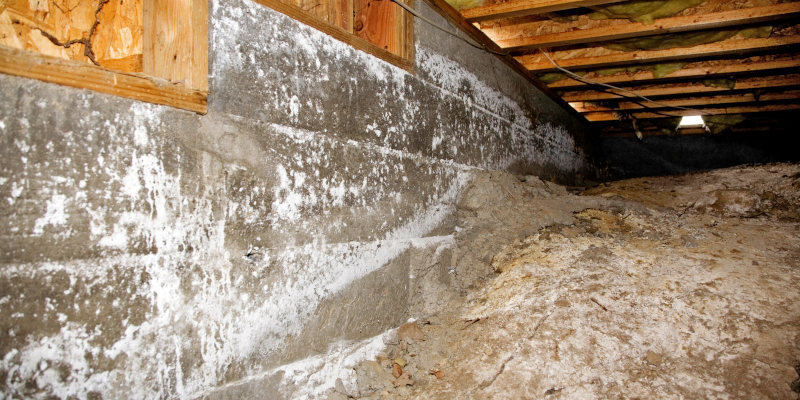
It’s uncommon for homeowners to spend a lot of time in their crawlspace. What is common for homeowners is a crawlspace mold issue, but because this area of the home is often ignored, mold in a crawlspace can continue to grow and spread without being addressed. Like mold anywhere else in the home, crawlspace mold needs to be handled properly and by the right team of mold removal experts.
What many people don’t realize is that mold growth in a crawlspace is a common problem for many homeowners. This is because the crawlspace has the perfect humidity that mold needs to grow. Mold grows and spreads quickly in a crawlspace, and even though you probably don’t venture into your crawlspace very often, the presence of this growth should not be ignored.
Crawlspace mold can spread from your crawlspace to the rest of your home. This poses a threat not only to the physical structure of your home as the mold wears away at the structural support system, but also to your and your family’s health. Mold spores can make you sick if you breathe them in.
Learn to recognize the signs of crawlspace mold early so that you can be quicker to address this mold before its growth spreads out of control. Make note of musty odors that come from mold. Pests and bugs love mold, so if you have a budding pest problem in your crawlspace, there may be mold present.
The best thing you can do to handle the mold in your crawlspace is to call us here at Remtech Environmental. Our certified team of mold removal technicians will identify all of the mold in your crawlspace before removing it. We’ll also recommend how to avoid crawlspace mold in the future as much as possible, so call us when your home is facing a mold issue.
If your home in North Carolina has a vented crawlspace, you almost certainly have mold underneath it right now. That is not hyperbole. The Advanced Energy field studies conducted across the southeastern US, including extensive work in NC, found visible mold in roughly 60 to 70 percent of vented crawlspaces sampled. The reason is not poor maintenance. It is building science. Vented crawlspaces were a 1950s code response to radon and termite concerns that made sense in dry climates but actively cause mold in humid subtropical zones like ours. Combine NC's Cfa climate, with summer outdoor dew points routinely above 72 degrees, with framing temperatures that sit in the mid-60s under air-conditioned homes, and you have a condensation factory operating eight months a year. This guide explains exactly why crawlspace mold is essentially the default condition in NC, what the signs are, and why encapsulation has become the standard solution for homeowners serious about long-term moisture control.
Why Vented Crawlspaces Grow Mold in North Carolina
Crawlspace mold is not bad luck. It is the predictable output of three building dynamics interacting with NC's climate.
Vapor Drive From Humid Outdoor Air
On a typical July afternoon in Raleigh the outdoor temperature might be 88 degrees with 70 percent relative humidity, producing a dew point near 76 degrees. That outdoor air enters the crawlspace through the foundation vents code requires. Inside the crawlspace the framing, ductwork, and subfloor sit at roughly 65 degrees because the conditioned space above is air-conditioned. Anytime humid air contacts a surface below its dew point, water condenses. The crawlspace becomes a giant cold-side condensation surface for eight months a year. We routinely measure crawlspace relative humidity above 90 percent during NC summers, which is well above the 70 percent threshold at which most molds begin active growth. No amount of cleaning will solve this problem because the physics keep refilling the moisture every day. The 1950s assumption that ventilation dries crawlspaces is correct only when outdoor air is drier than indoor air, which in NC is true in winter and false in summer.
Ground Moisture Through Failed Vapor Barriers
Beneath the average NC crawlspace soil sits damp clay or sandy loam with a permeance value high enough to release several gallons of water vapor per day per 1,000 square feet of dirt floor. Building code requires a six-mil polyethylene vapor barrier covering 100 percent of the soil, but in practice we find this barrier missing entirely, torn, only partially installed, or pulled back during plumbing or HVAC work. Without an intact ground cover, soil moisture migrates upward as vapor and saturates the air space, condensing on cold surfaces. Even with a code-minimum six-mil barrier, taped seams and overlaps degrade within three to five years, allowing vapor leaks. The encapsulation industry now uses 12-to-20-mil reinforced liners with mechanically sealed seams precisely because the code minimum was never adequate for NC conditions.
Plumbing Leaks and HVAC Condensation
Crawlspaces house water supply lines, drain lines, and frequently HVAC equipment and ductwork. Each of these is a potential moisture source. Slow drain leaks from cast iron pipe joints, weep leaks from copper pinhole corrosion, and full failures of polybutylene supply lines (still present in many 1980s NC homes) deposit hundreds of gallons over months without any obvious symptom upstairs. HVAC equipment installed in the crawlspace generates condensate from cooling, and clogged drain pans or improperly pitched condensate lines flood the surrounding subfloor regularly. Supply ductwork running through the warm, humid crawlspace becomes a condensation surface itself when chilled supply air cools the metal jacket below the surrounding dew point. We find dripping ducts in roughly half the crawlspaces we inspect during NC summers. Each of these moisture sources, individually small, compounds with the vapor and ground sources above to maintain colony-supporting conditions year-round.
Inadequate Insulation and Air Sealing
Many NC crawlspaces have fiberglass batt insulation stapled to the underside of the subfloor with the kraft paper facing pointing down. This is essentially a moisture trap. Humid crawlspace air infiltrates the batt from below, hits the cold subfloor, condenses, and saturates the insulation. The wet kraft paper is excellent food for mold. Fiberglass insulation hanging in sagging strips from joists is a near-universal sign that the assembly has been wet for years. Gaps in the rim joist, holes around plumbing penetrations, and uncaulked subfloor seams allow conditioned air to leak from above and cold air to leak in from below, both of which produce condensation. Building science guidance from the US Department of Energy now explicitly recommends removing under-floor insulation when converting to a sealed crawlspace because the assembly is fundamentally wrong for our climate.
Hurricane and Storm Saturation Events
Beyond the chronic conditions above, NC crawlspaces are periodically saturated by tropical systems. Hurricanes Florence, Matthew, Helene, and dozens of named tropical storms have driven horizontal rain into foundation vents, soaked rim joists, and flooded crawlspaces across the state. Even homes that did not experience overland flooding can have crawlspaces inundated by rising groundwater for days. After each event, framing moisture content can climb above 28 percent, well above the 16 percent threshold at which mold remains dormant. Without active drying, those colonies establish within seven to ten days and persist. We do significant volumes of post-storm crawlspace mold remediation across coastal and Piedmont NC counties precisely because chronic conditions plus acute saturation events produce nearly universal contamination.
Encapsulation: The Permanent Solution for NC Crawlspaces
How Crawlspace Mold Affects the Whole Home
Homeowners often dismiss crawlspace mold because they never go down there. The thinking is that what happens below the floor stays below the floor. The science says otherwise. Building scientists have demonstrated that air pressure dynamics in a typical NC home cause roughly 40 to 50 percent of the air a homeowner breathes upstairs to originate in the crawlspace. This is the stack effect: warm air rises out of the upper floors through ceiling penetrations, and replacement air is drawn up from below through floor penetrations like plumbing chases, electrical boxes, and the gaps around bathtubs and bathroom plumbing. As that crawlspace air rises, it carries spores, mVOC odors, and sometimes mycotoxins into the conditioned space. We routinely find Aspergillus and Penicillium counts inside crawlspace air samples that exceed outdoor counts by ten to fifty times, and corresponding elevated counts in upstairs air samples. The result is the persistent musty smell most NC homeowners with vented crawlspaces eventually notice, often blamed on old furniture or a damp basement when the actual source is below their feet. Crawlspace mold also damages structure. The fungi consume cellulose in joists, subfloor sheathing, and beam wood, gradually reducing structural integrity. We have replaced sections of subfloor in homes where the OSB had been so thoroughly colonized it had the texture of damp cardboard. Termites are also attracted to high-moisture wood, so chronic crawlspace humidity tends to bring secondary infestations. None of these problems stay contained to the crawlspace.
Get Professional Help in NC
If your home has a vented crawlspace and a musty smell, sagging insulation, or visible mold on joists, Remtech Environmental can break the cycle. We perform certified crawlspace mold remediation followed by full encapsulation throughout central NC, including Raleigh, Durham, Cary, Chapel Hill, Greensboro, Winston-Salem, and Fayetteville. Our crews handle the dirty work, document the remediation to S520 standards, and deliver a sealed, dehumidified crawlspace that ends the recurring mold problem permanently. Stop paying for the same crawlspace mold cleanup every few years.
Key Takeaways
- 60 to 70 percent of vented crawlspaces in the southeastern US contain visible mold; vented crawlspaces are fundamentally incompatible with NC's humid Cfa climate.
- Summer vapor drive into cool, air-conditioned crawlspaces produces continuous condensation on framing and ductwork, with measured relative humidity routinely above 90 percent.
- Roughly 40 to 50 percent of the air a homeowner breathes upstairs originates in the crawlspace via the stack effect, distributing mold spores and mVOCs throughout the home.
- Hurricane saturation events compound chronic conditions, producing post-storm crawlspace contamination across coastal and Piedmont counties.
- Encapsulation with a 12-to-20-mil sealed vapor barrier, foam-sealed rim joist, and dedicated dehumidifier is the building-science correct solution and pays back through HVAC and structural savings.
Need Help with Environmental Services?
If you have concerns about mold, asbestos, or water damage in your property, contact Remtech Environmental today for a free consultation.
Get a Free Quote