
What You Need to Know About Mold Remediation
Published by Remtech Environmental Team · Last updated April 2025
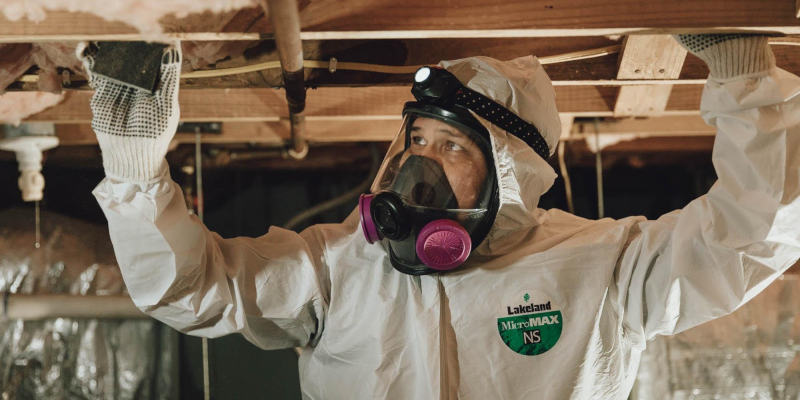
Our team at Remtech Environmental has extensive experience in dealing with mold, so you can turn to us whenever you need help with a mold problem. We offer complete mold remediation services, and you can count on us to eliminate the mold from your home and to take steps to prevent it from coming back. In this article, we will go over some key information you should know about how mold remediation works.
- Inspection – First, our team will inspect your home (or other property) to locate any and all areas affected by mold. Once we have identified the moldy areas, we will create a detailed plan to deal with each one.
- Sealing – The next step in the mold remediation process is to seal off the affected areas. Our team will install plastic sheeting around the mold-affected areas of the building to prevent spores from escaping into the healthy areas as we work. By keeping the spores contained inside these boundaries, we can prevent the mold from spreading or coming back. We will also use HEPA-equipped air filtration devices to clean the air and prevent the migration of mold spores into other areas.
- Removal – After sealing off the affected areas, our mold remediation team will begin the process of removing the moldy materials. Many materials cannot be saved after they become damaged by mold—for example, it’s often impossible to completely eliminate mold from a carpet, upholstery, or other porous materials—so these materials need to be removed and disposed of.
- Disinfection – Another part of the mold remediation process is cleaning and disinfection. While some materials will need to be disposed of, other materials are more resistant to mold damage and can be salvaged as long as they are thoroughly cleaned. Our team will use EPA-listed cleaning agents to eliminate any mold present on these surfaces.
Mold remediation is not a deep-cleaning service. It is a structured engineering process governed by the IICRC S520 Standard for Professional Mold Remediation, and skipping any of its phases tends to leave a property worse off than when the work began. North Carolina homeowners deal with this reality more than most. The state sits squarely in a humid subtropical Koppen Cfa zone, where summer dew points routinely climb above 70 degrees and indoor relative humidity hovers near 80 percent for months at a time. Add hurricane-driven flooding, leaky vapor barriers, and aging HVAC systems, and the conditions for fungal colonization are nearly always present. At Remtech Environmental, we have remediated thousands of homes across the Triangle, Triad, and Sandhills regions, and the homeowners who call early almost always pay less than the ones who wait. This guide walks through what professional mold remediation actually involves, when you need it, and why DIY attempts so often fail in our climate.
The IICRC S520 Remediation Process Step by Step
Every Remtech project follows the IICRC S520 framework, the only nationally recognized consensus standard for mold remediation. Here is what each phase looks like in practice.
Assessment and Moisture Mapping
Before any containment is built, our certified technicians perform a complete assessment using moisture meters, thermal imaging, and air sampling when warranted. The goal is to find every active source of water intrusion, because remediating mold without fixing the moisture problem guarantees regrowth. In North Carolina homes we frequently identify three culprits: failed crawlspace vapor barriers, condensation on supply ducts in unconditioned attics, and chronic plumbing leaks behind vanities. Documentation at this stage also protects you for insurance claims under most homeowner policies. We map every Condition 2 (settled spores) and Condition 3 (active growth) area before generating a written remediation protocol that defines scope, materials to be removed, and clearance criteria. Skipping assessment is the single most common reason DIY jobs fail.
Engineering Controls and Containment
Containment is what separates remediation from contamination. We build critical barriers using six-mil polyethylene sheeting, seal HVAC supply and return registers, and establish negative air pressure inside the work area using HEPA-filtered air scrubbers rated for the cubic footage. Negative pressure means air flows into the containment, never out, so spores released during demolition cannot migrate through the home. For larger projects we install decontamination chambers with three stages so technicians can doff PPE without tracking spores into clean areas. This is the step that most untrained homeowners skip entirely, and it is the reason a small bathroom mold problem can become a whole-house contamination event after a weekend of bleach and elbow grease.
Removal of Porous Materials
Mold colonizes the cellulose in drywall, the backing on carpet, the paper on insulation, and the fibers in upholstery. Once hyphae penetrate these materials they cannot be cleaned, only removed. Per S520, we discard porous materials with visible Condition 3 contamination, double-bag them at the containment boundary, and dispose of them as construction debris (mold itself is not regulated as hazardous waste in NC, but cross-contamination is the concern). Semi-porous materials like dimensional lumber and concrete are typically salvageable through HEPA vacuuming, damp wiping with detergent, and antimicrobial application. We do not use bleach as a primary biocide. EPA studies have shown bleach loses efficacy on porous surfaces because the water carrier penetrates while the chlorine evaporates, often feeding regrowth.
HEPA Cleaning and Antimicrobial Treatment
After demolition, every surface inside the containment receives a three-pass cleaning: HEPA vacuum, damp wipe with EPA-registered detergent, and final HEPA vacuum. HEPA filters capture 99.97 percent of particles down to 0.3 microns, which is small enough to trap individual mold spores. We follow with an EPA-registered antimicrobial selected for the specific contamination, never a residential product purchased off a hardware store shelf. Many home cleaners simply mask odor or kill surface mold without addressing the spores embedded in dust. Our antimicrobials are applied at the manufacturer's labeled dwell time, then allowed to dry without rinse so the residual film inhibits regrowth while the structure dries below the 16 percent moisture threshold required for fungal dormancy.
Post-Remediation Verification
We do not declare a job complete because the surface looks clean. The S520 standard requires a clearance step, ideally performed by an independent third-party Industrial Hygienist who collects air samples inside the former containment and compares them to outdoor controls. If interior spore counts exceed exterior baselines or contain elevator-class molds like Stachybotrys, the area fails clearance and we re-clean at no charge. This step is what gives homeowners and buyers documented proof that the property is safe. Most DIY remediations have no clearance whatsoever, which is why mold problems are routinely flagged years later during real estate transactions, costing sellers tens of thousands in last-minute concessions.
When You Should Call a Professional Versus Watching and Waiting
Why North Carolina's Climate Makes Remediation More Complex
Remediation protocols developed in Arizona or Colorado do not translate directly to North Carolina. Our state's humid subtropical climate creates persistent moisture loading that simply does not exist in arid regions. Summer outdoor dew points in Raleigh, Greensboro, and Wilmington routinely exceed 70 degrees Fahrenheit for ten to twelve weeks. When that humid outdoor air contacts cooler surfaces inside vented crawlspaces or air-conditioned wall cavities, condensation forms on framing, ductwork, and the underside of subfloors. This is not a leak in the traditional sense. It is the laws of psychrometrics operating on a building envelope that was not designed for them. Coastal counties add hurricane risk, with Florence (2018), Matthew (2016), and Helene (2024) each generating wind-driven rain intrusion that saturated wall assemblies through siding penetrations and roof flashings. Most homeowners do not realize they have water damage until mold appears six to twelve weeks later behind baseboards. Effective remediation in NC therefore requires dehumidification as part of the drying phase, often using LGR (low grain refrigerant) dehumidifiers capable of pulling moisture from air at 40 percent relative humidity. We also coordinate with crawlspace encapsulators and HVAC contractors when the underlying moisture source is structural, because spot-treating mold without changing the building science guarantees a callback within eighteen months.
Get Professional Help in NC
Remtech Environmental serves homeowners and property managers across central and eastern North Carolina with full IICRC S520 mold remediation. We dispatch certified crews to Raleigh, Durham, Chapel Hill, Cary, Greensboro, Winston-Salem, and Fayetteville for assessment, containment, removal, and post-remediation clearance. Whether you have visible mold after a hurricane, persistent musty odors in a vented crawlspace, or a real estate transaction that flagged contamination, our team produces the documentation insurers and buyers require. Call us for a written remediation protocol grounded in the S520 standard and tailored to North Carolina's climate.
Key Takeaways
- Mold remediation follows the IICRC S520 standard, a five-phase engineering process that includes assessment, containment, removal, cleaning, and post-remediation verification.
- North Carolina's humid subtropical (Koppen Cfa) climate, with summer relative humidity above 80 percent, creates persistent moisture loading that fuels regrowth if the source is not corrected.
- Containment with negative air pressure and HEPA filtration is the step DIYers skip and the reason small mold problems become whole-house contamination events.
- Porous materials (drywall, carpet, insulation) with active mold growth must be removed and disposed of, not cleaned, because hyphae penetrate beyond the surface.
- Independent post-remediation clearance testing is the only objective proof a remediation worked, and it is what insurers and home buyers require.
Need Help with Environmental Services?
If you have concerns about mold, asbestos, or water damage in your property, contact Remtech Environmental today for a free consultation.
Get a Free Quote