
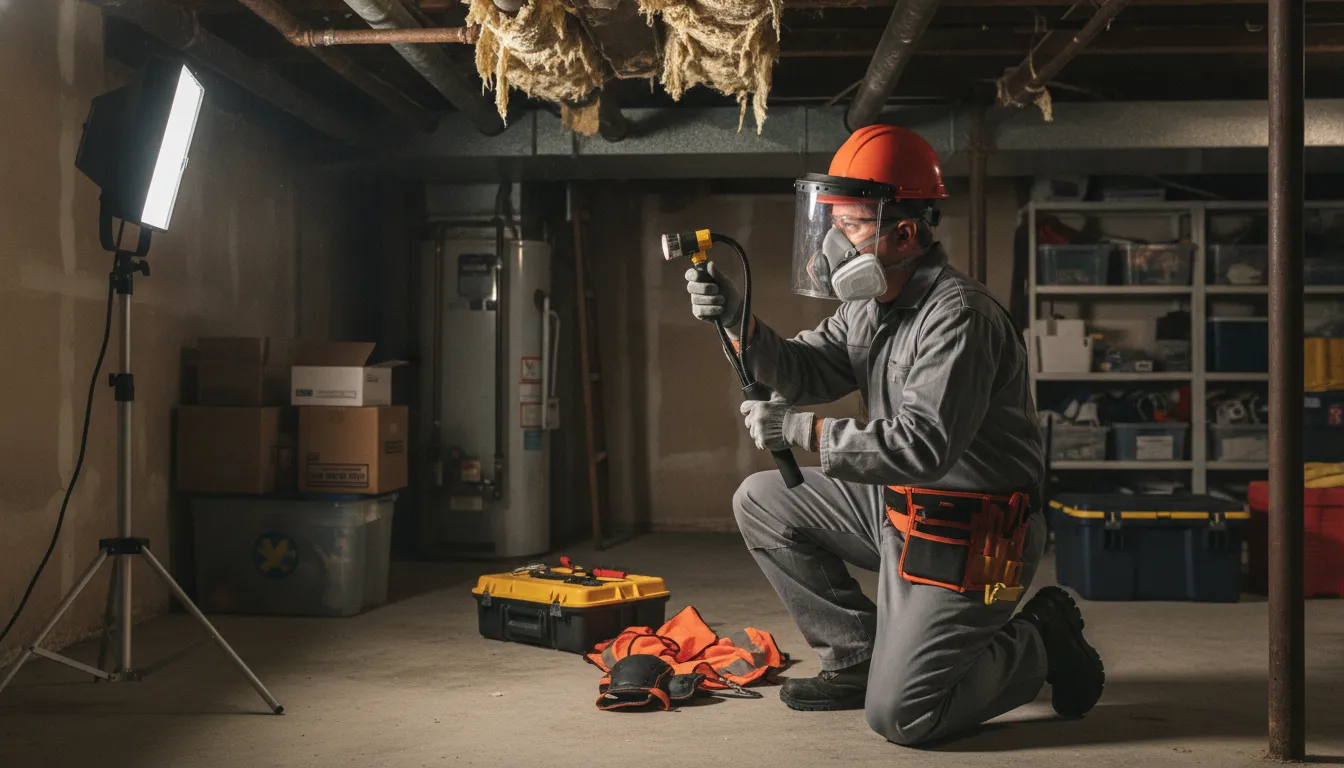
Older Raleigh homes can contain asbestos insulation around pipes, boilers, and plumbing fixtures, especially when those materials were installed before the 1975 ban. What looks like ordinary wrap, spray, or block insulation may require careful handling, but appearance alone cannot confirm asbestos.
For asbestos pipe insulation removal raleigh nc, the safest first step is to avoid touching or disturbing the material and arrange an assessment by a trained, accredited professional. Laboratory analysis is the reliable way to confirm whether asbestos is present, and a professional can explain whether leaving, encapsulating, or removing it is appropriate.
Get a free quote today for professional asbestos pipe insulation removal in Raleigh, NC.
That measured approach reflects the goal of doing the right work the right way: protect the people in the home without creating unnecessary alarm. Start by learning which visual clues can suggest asbestos pipe insulation and why they are only clues, not a diagnosis.
What Does Asbestos Pipe Insulation Look Like?
In a Raleigh home, suspected asbestos pipe insulation may look like an ordinary aging plumbing wrap, but its appearance can vary. Older insulation is often found around hot or cold water pipes, boilers, and nearby plumbing fixtures. Homes built before 1975 are especially likely to contain it because asbestos was the industry-standard insulation material for water pipes and boilers before it was banned in 1975.
Corrugated wraps around pipes
The most recognizable form is a white or gray wrap with a ridged, corrugated surface. It can resemble thick paper, cardboard, or layered fabric wound around a pipe. The surface may be uneven, brittle, or discolored from age. You may also see seams where sections of the wrap meet, especially around pipe elbows, valves, or fittings.
White cloth tape or fabric wrapping
Some pipe insulation has a smooth or slightly textured white cloth outer layer. It may look like wide tape, gauze, or fabric wrapped repeatedly around the pipe. Over time, this covering can yellow, gray, fray, or loosen at the edges. A cloth-like appearance does not confirm asbestos, and the material underneath may be more important than the outer covering.
Spray-on and block insulation
Asbestos insulation was also applied as a spray or formed into solid blocks. Spray-on material may have a rough, plaster-like texture that follows the shape of a pipe, boiler, or fitting. Block insulation is more commonly associated with boilers. It may appear as white or gray sections about one inch thick. Sometimes glued directly to a nearby wall, particularly where a boiler was installed close to the wall. Wraps, sprays, and blocks are the three common forms used for pipes and plumbing fixtures.
Why appearance is not enough
Visual clues can help you recognize material that should be treated cautiously, but they cannot identify asbestos with certainty. The EPA explains that you generally cannot tell whether a material contains asbestos simply by looking at it. Only laboratory analysis of a properly collected sample can confirm its presence. Do not scrape, cut, pull, or handle a suspected wrap to inspect what is underneath. Leave it undisturbed and arrange for a trained, accredited professional to evaluate and sample it safely. Read the EPA's guidance on identifying asbestos.
Where Is Asbestos Pipe Insulation Found in Older Raleigh Homes?
In older Raleigh homes, asbestos pipe insulation is most often found wherever plumbing or heating lines run through lower, utility, or service areas. That includes basements, crawlspaces, boiler rooms, and spaces around hot water heaters. It may appear on hot and cold water pipes, heating pipes, steam pipes, boiler wraps, and nearby plumbing fixtures. These areas can be easy to overlook until a renovation, repair, or inspection brings them into view.
Age is an important starting point. Asbestos pipe insulation was the industry-standard way to insulate water pipes and boilers before it was banned in 1975. Many Raleigh homes built during the mid-century boom, particularly from the 1940s through the 1970s, may therefore contain this material. Older housing stock in neighborhoods such as Five Points, Cameron Park, Oakwood, and Boylan Heights deserves careful attention, especially when original mechanical systems remain in place.
Common locations to check
- Basements: Look for insulated water lines, heating pipes, boiler connections, and pipe elbows.
- Crawlspaces: Pipes may run beneath floors or alongside foundations, often in confined areas where access is limited.
- Boiler rooms: Boilers and the connected steam or heating pipes may have older insulation wraps or other coverings.
- Around hot water heaters: Insulation may be present on connecting pipes, valves, or nearby fixtures.
Location and appearance can raise a reasonable concern, but they cannot confirm what a material contains. The EPA advises treating questionable material as asbestos and leaving it alone until a trained, accredited professional can evaluate and sample it. If the insulation is intact and will not be disturbed, leaving it undisturbed is generally the safest immediate approach. Damage, planned remodeling, or needed mechanical work calls for professional asbestos testing in Raleigh before anyone cuts, scrapes, removes, or repairs the insulation. EPA guidance on asbestos exposure provides additional safety information.
When Is Asbestos Pipe Insulation Dangerous?
Asbestos pipe insulation is not automatically an immediate hazard. The EPA explains that asbestos-containing material in good condition and left undisturbed is generally not likely to pose a health risk. If the insulation is intact and no work is planned nearby, leaving it alone may be the safest course of action. The EPA recommends avoiding disturbance rather than treating every older material as an emergency.
Learn about Remtech Environmental's full asbestos services or request a free quote for your Raleigh-area property.
When the material can release fibers
The risk changes when pipe insulation is damaged, friable, or disturbed. Friable material can be crumbled or reduced to powder by hand, making it more likely to release airborne fibers. Cutting, scraping, drilling, sanding, tearing, or removing the insulation improperly can also release fibers, according to the EPA. Repeated rubbing, handling, extreme vibration, or strong airflow can create additional opportunities for fiber release. These conditions require careful control, not casual inspection or cleanup.
Age alone does not determine whether the insulation is dangerous. Look instead for visible deterioration, loose or crumbling sections, exposed pipe wrap, debris, or areas that have been hit or rubbed. Even slightly damaged material should not be touched. The EPA advises limiting access and leaving it undisturbed unless a qualified professional determines that further action is needed. Do not sweep, vacuum, or handle suspected debris.
Why asbestos exposure matters
All forms of asbestos are hazardous when exposure occurs. Asbestos fibers can contribute to serious diseases, including mesothelioma, asbestosis, and lung cancer. Some forms, including amphibole asbestos, are considered somewhat more hazardous than chrysotile. The National Institutes of Health summarizes these health risks in its asbestos toxicology reference.
If you are planning renovations near older pipe insulation, keep people away from the area and arrange a professional assessment before work begins. Remtech Environmental's trained, EPA-accredited specialists can determine whether sampling, repair, encapsulation, or asbestos pipe insulation removal in Raleigh, NC is appropriate without creating unnecessary disturbance.
Why You Should Never Remove Asbestos Pipe Insulation Yourself
Asbestos pipe insulation can look like an ordinary renovation obstacle, especially when it is wrapped around a pipe in a basement, crawlspace, or utility area. Treating it as a do-it-yourself project is a serious mistake. The EPA recommends using a trained and accredited asbestos professional before renovating older homes, because disturbing suspected asbestos can release fibers into the air. Read EPA guidance on asbestos exposure for more details.
Common renovation mistakes can spread fibers
Sanding, cutting, scraping, drilling, or pulling on pipe insulation can break down the material and make fibers airborne. Even an attempt to clear a small section for plumbing or electrical work can disturb a larger area than expected. Once released, fibers can move through the home on air currents or settle on nearby surfaces. DIY removal of asbestos pipe insulation is dangerous because it may contaminate the work area and expose household members who were not involved in the project.
Improper removal may also violate applicable requirements for asbestos work. In North Carolina, professional asbestos projects require 10-day advance notification to the North Carolina Department of Health and Human Services. That requirement is one reason this work should not be treated like routine pipe repair or demolition. Remtech Environmental follows all applicable NESHAP, AHERA, and OSHA requirements for every asbestos project.
Do not rely on appearance
Asbestos cannot generally be identified by sight alone. Pipe insulation may resemble other fibrous or cement-like materials, but visual inspection cannot confirm its contents. The EPA advises leaving material alone if you are unsure, and having samples collected for laboratory analysis by a trained, accredited professional. Review EPA sampling and safety guidance for further instruction.
If you suspect asbestos pipe insulation removal is needed in Raleigh, NC, stop work, keep people away from the area, and avoid touching or cleaning the material. A qualified professional can determine whether testing, removal, or another regulated solution is appropriate while protecting the rest of the home from unnecessary disturbance. Contact Remtech Environmental for a free consultation and project-specific guidance.
How Professionals Handle Asbestos Pipe Insulation Removal in Raleigh, NC
Professional asbestos pipe insulation removal in Raleigh, NC follows a controlled process designed to protect occupants, workers, and nearby areas. The goal is not simply to take material off a pipe. It is to prevent fiber release from the initial inspection through final clearance. Remtech Environmental uses EPA-accredited specialists with IICRC certification and comprehensive insurance coverage to execute every phase safely.
- Inspect the insulation and arrange laboratory testing. A qualified asbestos professional examines the pipe insulation, identifies areas that may be damaged or friable, and collects samples using controlled procedures. Trained technicians use sealed containment around the sampling area and wear appropriate respiratory protection during collection. Appearance alone cannot confirm asbestos. The EPA explains that trained, accredited professionals should take samples because improper handling can release fibers. Laboratory analysis using polarized light microscopy (PLM) or transmission electron microscopy (TEM) establishes whether asbestos is present and helps determine the appropriate work plan.
- Complete notifications and prepare the work area. In North Carolina, asbestos projects require 10-day advance notification to NC DHHS. Personnel working on asbestos must also have EPA-accredited training. Before removal begins, the crew seals off the work area with polyethylene sheeting, protects floor surfaces with disposable coverings, establishes a controlled entry and decontamination chamber, and uses negative air pressure units with HEPA filtration to keep potentially contaminated air from moving into occupied spaces. Strict containment and specialized safety equipment are central parts of professional removal.
- Remove the insulation while keeping it wet. Workers follow a carefully planned sequence and use wet removal methods required under NESHAP. Technicians apply water amended with a wetting agent using low-pressure sprayers to saturate the insulation before and during removal, reducing airborne dust as insulation is detached from pipes, elbows, or fixtures. The crew uses full-face respirators with P100 filters, disposable protective suits, and gloves, and avoids dry scraping, cutting, sanding, or other practices that could increase fiber release.
- Package and transport the waste correctly. Removed asbestos material is sealed in approved 6-mil poly bags or containers, labeled as asbestos waste with the required OSHA and DOT markings, and handled through EPA-compliant disposal procedures at permitted facilities. Proper packaging helps protect everyone who may encounter the material after it leaves the contained work area.
- Perform post-removal air clearance testing. After removal and cleanup, the containment area undergoes a visual inspection followed by air testing using phase contrast microscopy (PCM) to confirm fiber levels meet applicable clearance criteria before the space is returned to normal use. Clearance documentation provides evidence that the work area meets the applicable release criteria. For additional context, see our asbestos abatement process.
Remtech Environmental strictly follows NESHAP, AHERA, and OSHA standards for asbestos projects. That commitment reflects our approach of doing the right work the right way, with clear explanations and no scare tactics.
Asbestos Pipe Insulation: Removal vs. Encapsulation
Choosing between removal and encapsulation starts with the condition of the insulation and what will happen in the space. A professional assessment is important because pipe insulation may be friable or damaged, and the safest option depends on the material, its location, and the planned work. The EPA notes that asbestos-containing material in good condition is generally best left alone when it will not be disturbed.
| Factor | Removal | Encapsulation |
|---|---|---|
| Process | Extracts the asbestos-containing insulation entirely, using controlled work practices and appropriate disposal. | Seals the existing insulation so fibers are less likely to be released. The material remains in place. |
| When Recommended | Typically considered when insulation is damaged, friable, deteriorating, or likely to be disturbed. | May be appropriate for intact, undisturbed insulation that is in good condition and can remain safely in place. |
| Cost Implication | May involve more labor, containment, disposal, and project coordination. Pricing is specific to the site and scope. | May reduce the work required when the material can remain in place, but the condition and access still determine the project scope. |
| Durability | Removes the asbestos insulation from the affected area, eliminating the need to manage that material there. | Creates a protective barrier, but the encapsulated material remains and should be monitored for damage or future disturbance. |
| Suitability for Renovation | Usually the more suitable approach when renovation, repairs, or demolition would disturb the insulation. | Generally not suitable if planned work will cut, move, open, or otherwise disturb the encapsulated insulation. |
In practical terms, encapsulation can make sense when sound insulation can remain undisturbed. Removal is more appropriate when the material is damaged or when renovation changes the conditions around it. An accredited professional should evaluate the pipe insulation and explain the available options before work begins. The EPA advises that damaged or improperly disturbed asbestos materials may release fibers, so do not cut, scrape, or remove suspected insulation yourself. EPA asbestos safety guidance provides additional background.
Frequently Asked Questions
How do I know if my pipe insulation contains asbestos?
You cannot confirm asbestos by appearance alone. Older insulation may look like paper, fabric, plaster, or blocks, but a trained and accredited asbestos professional should collect a sample for laboratory analysis. Until testing is complete, treat questionable material as asbestos-containing and leave it undisturbed. The EPA explains why visual inspection is not enough.
Is asbestos pipe insulation safe if it is not damaged?
Material in good condition that will not be disturbed is generally unlikely to release fibers. The risk changes if insulation is cracked, torn, friable, rubbed, hit, or exposed to substantial vibration or airflow. Limit access to a slightly damaged area, avoid touching it, and arrange a professional assessment before repairs or renovation. EPA guidance recommends leaving sound material alone.
Should I attempt to remove asbestos pipe insulation myself?
No. Cutting, scraping, pulling, or otherwise disturbing pipe insulation can release hazardous fibers into the air. Do not sweep debris or remove the material before it has been evaluated. A qualified professional can determine whether removal, encapsulation, or another management approach is appropriate and establish safe work controls.
What does professional asbestos pipe insulation removal involve?
Professional abatement uses containment, specialized protective equipment, controlled removal practices, and compliant waste handling to limit fiber release. In North Carolina, asbestos projects require advance notification to NC DHHS, and workers must have EPA-accredited training. Applicable work practices include wet removal and properly labeled waste, with projects conducted under relevant NESHAP, AHERA, and OSHA requirements.
Ready to Discuss Asbestos Pipe Insulation Removal in Raleigh?
A professional consultation can help clarify the condition of suspected pipe insulation and the appropriate next step for your property. Remtech Environmental provides education-first guidance for Raleigh-area homeowners and businesses, without high-pressure sales language. To discuss your concerns and request project-specific guidance, get a free quote today.