
Water damage doesn’t just cause structural problems — it can also open the door for mold growth, pest infestations and health risks. Protect your home or business from lasting damage. Remtech Environmental uses the latest water damage repair technology to dry more effectively to restore your life faster and to help prevent subsequent mold issues from arising in the future.
Our certified water damage restoration specialists are available anytime, day or night in the Asheville, North Carolina area.
Reliably Thorough Service.
For over 20 years Remtech has restored residential and commercial properties from water damage and protected them from long term water damage.
When a storm or natural disaster damages your property, call the local team you can trust to get the job done right.
We are proud to Provide Water Damage Restoration Services All Across NC. At Remtech Environmental, our first priority is your safety — you can count on our water damage specialists for skilled service and attention to detail from start to finish.
Few cities in the country have lived through water damage on the scale Asheville experienced in September 2024. Hurricane Helene pushed a year's worth of rain into the southern Appalachians in 48 hours, sending the French Broad and Swannanoa rivers to record crests, scouring entire neighborhoods in the River Arts District and Biltmore Village, and leaving thousands of mountain homes saturated, silt-coated, and structurally compromised. The recovery is still underway, and the lessons from Helene now shape how Remtech Environmental responds to every water emergency in Western North Carolina. Even outside the historic storms, Asheville's terrain creates relentless water risk: steep grades push runoff against foundations, century-old Montford and Grove Park homes hide aging pipes in stone-walled crawlspaces, and winter storms regularly burst supply lines as temperatures swing from 60 F to single digits in 24 hours. Our certified water mitigation team is on call 24 hours a day, 7 days a week across Asheville and Buncombe County. When you call us, a real technician answers, and a truck is dispatched immediately to begin extraction, drying, and structural drying before mold and decay take over.
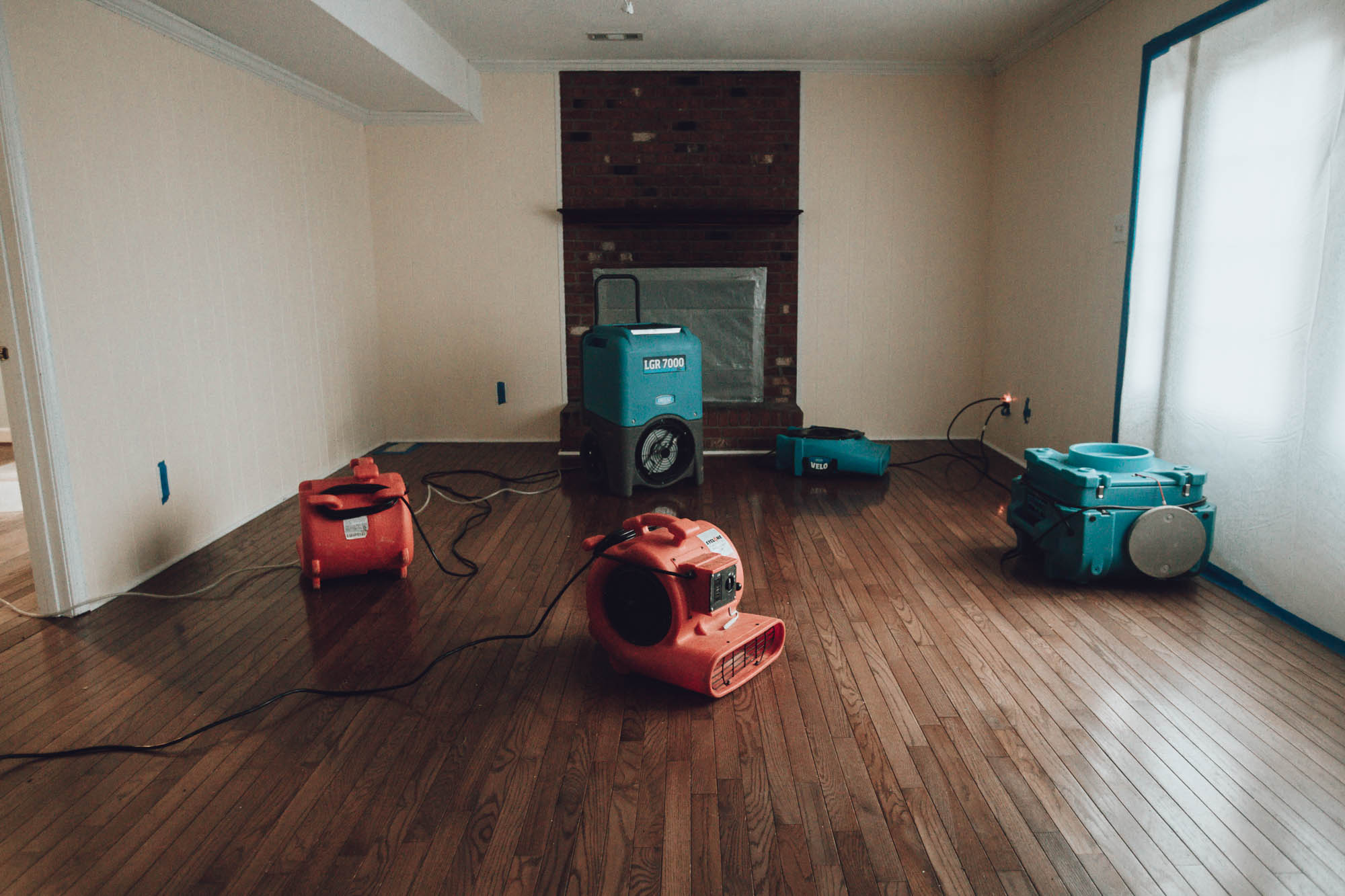
Time is the variable that decides whether a leak becomes a renovation. Drywall wicks moisture upward almost an inch per hour, hardwood cups within an afternoon, and mold can begin colonizing wet substrates in 24 to 48 hours. Remtech Environmental staffs an on-call team for Asheville and the Western NC region every night, weekend, and holiday. After Hurricane Helene we expanded our Western NC capacity significantly, adding equipment, crews, and dispatch capability so we can respond to losses in Asheville proper, Black Mountain, Weaverville, Fairview, Arden, and Candler without the days-long wait that some homeowners experienced in the immediate aftermath of the storm. Our trucks roll with truck-mounted extractors, high-volume submersible pumps for flooded basements and crawlspaces on steep mountain lots, commercial air movers, LGR dehumidifiers calibrated for cool mountain ambient conditions, infrared cameras, calibrated moisture meters, and EPA-registered antimicrobials. We document the loss the moment we arrive. When you call our emergency line, a certified technician answers and dispatches a real truck.
Asheville's combination of mountain terrain, four-season weather extremes, and a housing stock that ranges from 19th-century Victorians to modern mountain modern builds drives water losses from many directions. These five sources dominate our calls.
Western NC winters routinely whipsaw between 60 F afternoons and overnight lows in the single digits, and pipes feel every degree of that swing. Many Montford, Grove Park, North Asheville, and Kenilworth homes have copper supply lines threaded through stone foundations, unconditioned crawlspaces, and exterior walls where insulation thins out. The December 2022 Arctic blast and the January 2025 cold snap each generated waves of burst-pipe calls across Buncombe County. By the time the homeowner discovers the leak, hundreds of gallons may already have soaked through subfloors, plaster ceilings, and finished basement spaces.
Hurricane Helene's September 2024 landfall was the worst flooding event in Western NC's recorded history. The French Broad crested at levels not seen since 1916, the Swannanoa overran its banks, entire blocks of the River Arts District and Biltmore Village were submerged, and mountain creeks that normally trickle became destructive torrents. Even outside Helene, tropical remnants periodically push 6 to 12 inches of rain across the southern Appalachians, and the steep terrain converts that rainfall into fast-moving runoff that finds basements, crawlspaces, and slab-level walkouts almost immediately.
Asheville's mountain weather brings heavy summer thunderstorms, hail, and wind-driven rain that lift shingles and overwhelm gutters fast. The dense tree canopy across North Asheville, Beaverdam, and Town Mountain fills gutters with leaves and pine straw within weeks, sending overflow back under the drip edge or against fascia. Older slate, metal, and cedar shake roofs on Montford and Grove Park historic homes have their own vulnerabilities, with failed flashing around dormers and chimneys driving slow leaks that show up as ceiling stains and rotted decking long after the original storm has moved on.
Supply lines on washers, dishwashers, ice makers, and water heaters live under constant pressure, and the hoses fatigue over a 10 to 15 year window. When one fails behind an Asheville laundry wall or under a kitchen island, the loss can release 600 gallons per hour until the main shutoff is closed. Water heater tank failures are especially punishing in mountain homes where tanks sit in attic platforms, second-floor closets, or finished basements, because the water cascades through ceilings, electrical fixtures, and floors before anyone realizes there is a problem.
Asheville's mix of clay soils, granite bedrock, and steep grades pushes hydrostatic pressure against foundations during sustained rain. We see groundwater seeping through old stone basement walls in Montford and Grove Park, daylight basement walkouts flooding when uphill grading fails, and aging clay sewer laterals collapsing or root-intruding and backing up sewage into ground-floor bathrooms. Sewer backups are Category 3 black water and require full PPE, contaminated material removal, and professional sanitization to safely return the home to service.
Every loss is different, but our IICRC-aligned process follows the same disciplined sequence so nothing falls through the cracks. Here is what to expect when Remtech arrives at your Asheville home.
Our lead technician walks the loss with you, identifies the source, and stops the flow if it is still active. We use calibrated moisture meters, hygrometers, and thermal imaging to map every pocket of saturation, including hidden water in stone-walled crawlspaces, behind plaster, and under tongue-and-groove flooring common in older Asheville homes. We classify the water (Category 1, 2, or 3) and damage class (1 through 4), photograph everything for your insurance file, and walk you through the scope of work before any equipment leaves the truck.
Standing water comes out first. Our Asheville trucks carry truck-mounted and portable extractors capable of pulling thousands of gallons per hour, plus high-volume submersible pumps for flooded mountain basements and crawlspaces on steep lots where conventional pumping struggles. We extract from carpet, pad, hard surfaces, and behind baseboards using weighted wands that pull bound water out in a single pass. The faster we remove the bulk water, the less demolition is required downstream.
Asheville's mountain humidity is lower than the Piedmont's but still climbs in summer, and cool mountain ambient temperatures can actually slow drying if dehumidifiers are not calibrated correctly. We deploy commercial air movers paired with low-grain refrigerant dehumidifiers sized to the cubic footage and ambient conditions of each loss. We monitor moisture content in framing, subfloor, plaster, and drywall daily, adjust equipment placement based on the readings, and keep psychrometric logs documenting the structure's return to dry standard. Most residential losses reach dry standard in 3 to 5 days when equipment is sized correctly.
Once the structure is dry, we apply EPA-registered antimicrobials to affected substrates to neutralize bacteria and prevent mold from establishing on damp organic material. For Category 2 and 3 losses, including the silt-laden floodwater many post-Helene homes carried, we go further, removing porous materials that cannot be reliably decontaminated, HEPA vacuuming framing, and air-scrubbing the workspace with HEPA filtration. If mold is already present, we transition into containment and remediation under IICRC S520 protocols rather than masking the problem.
With the structure dry and clean, we rebuild what came out: drywall, plaster repair where appropriate for historic homes, insulation, baseboards, flooring, paint, cabinetry, and trim. Our crews handle most repairs in-house and coordinate with vetted Asheville and Western NC subcontractors for plumbing, electrical, and specialty work. We match existing finishes wherever possible, which matters especially in Montford and Grove Park historic homes, and we walk the completed job with you and your adjuster before signing off.
The insurance landscape in Asheville post-Helene has been particularly difficult for homeowners, and the standard versus flood distinction is the single most important variable in your claim. Standard North Carolina homeowner's policies cover sudden and accidental water discharge, which includes burst pipes, supply line failures, water heater ruptures, and overflowing appliances. They exclude flood, defined as rising surface water from rain, river overflow, or storm-driven inundation. Flood damage requires a separate NFIP policy, and many Western NC homeowners outside designated FEMA flood zones did not carry flood coverage when Helene arrived. If your loss is from rising river or creek water, it is a flood claim. If your loss is from a burst pipe, a roof leak, or an appliance failure, it is typically a homeowner's claim. Gradual leaks and deferred maintenance are commonly excluded. Remtech provides the documentation your adjuster needs: dated photographs, moisture mapping diagrams, daily drying logs, equipment placement records, psychrometric readings, and itemized scopes built in Xactimate, the same platform most carriers use. We work directly with adjusters from State Farm, Allstate, USAA, NC Farm Bureau, Erie, Nationwide, Liberty Mutual, Travelers, Auto-Owners, and the NFIP-affiliated flood carriers. We flag common issues early, including ACV versus RCV depreciation, mold sublimits that often cap at $5,000 to $10,000, and matching disputes for flooring, plaster, and cabinetry in older Asheville homes. North Carolina law guarantees you the right to choose your own restoration contractor.
Our Asheville emergency line is staffed 24 hours a day by a certified water damage technician. From the moment you call, we typically have a truck on site within 45 to 75 minutes for addresses in central Asheville, Montford, North Asheville, West Asheville, Biltmore Village, and Kenilworth, and within 60 to 90 minutes for outlying communities like Black Mountain, Weaverville, Fairview, Arden, and Candler. After Hurricane Helene we expanded Western NC capacity meaningfully, so even in a regional surge event we can hold reasonable response times across Buncombe County.
It depends on the source. Standard North Carolina homeowner's policies cover sudden and accidental water damage, which includes burst pipes, water heater failures, dishwasher and washing machine leaks, and similar internal events. They do not cover flood, which is rising surface water from heavy rain, river overflow, or hurricane-driven inundation, and which requires a separate NFIP flood policy. Many Asheville homeowners learned this distinction painfully during Helene. Gradual leaks and deferred maintenance are also commonly excluded. We help you read your policy and document the loss so the right claim path is followed.
Mitigation, meaning extraction, drying, and sanitizing, usually takes 3 to 5 days for a typical Asheville residential loss. Category 3 contaminated losses, silt-laden flood losses, or large mountain-home losses can run 7 to 14 days in mitigation alone. After mitigation, the rebuild phase covers drywall, plaster, paint, flooring, and trim, and timeline depends on scope and material lead times. Post-Helene material backlogs in Western NC can extend rebuild timelines further. We give you a realistic schedule at the initial assessment and update it as conditions change.
Many Asheville homeowners stay in their home through mitigation. Drying equipment is loud and warm but generally safe to live around as long as the affected area is sealed off and the rest of the house is unaffected. You should consider relocating if the loss involves the only kitchen or bathroom, if Category 3 black water or post-flood silt contamination is present, or if a household member has asthma, severe allergies, or is immunocompromised. Most homeowner's policies include Additional Living Expense coverage that pays for hotel or rental stays in those scenarios.
It is the most consequential distinction on your claim, especially in Western NC after Helene. Water damage refers to water originating inside the home, like a burst supply line, a failed water heater, a leaking dishwasher, or a roof leak. That category is covered under standard homeowner's insurance. Flood damage refers to water rising from outside the home, including the French Broad and Swannanoa river overflow, mountain creek surges, and accumulated rainfall pooling against a foundation. Flood is excluded from every standard homeowner's policy in North Carolina and requires a separate NFIP flood policy or private flood coverage.
Remtech Environmental responds to water damage emergencies across Asheville and the surrounding Western NC region, including Biltmore Forest, Biltmore Village, Montford, Grove Park, North Asheville, West Asheville, Kenilworth, Beaverdam, Town Mountain, Haw Creek, the River Arts District, downtown Asheville, and Oakley. We also serve Buncombe County and the broader Western NC mountain region, with active service in Black Mountain, Weaverville, Fairview, Arden, Candler, Swannanoa, Hendersonville, Fletcher, Waynesville, and Brevard, including communities still recovering from Hurricane Helene's 2024 impact.
Contact us today to schedule an inspection or receive a free quote for our services.
Get a Free QuoteReady to get started? Fill out the form below and we'll get back to you right away.
We believe that a job done right is the only way to sleep well at night.
Contact Us Today